
lith=stone,表明“石头”
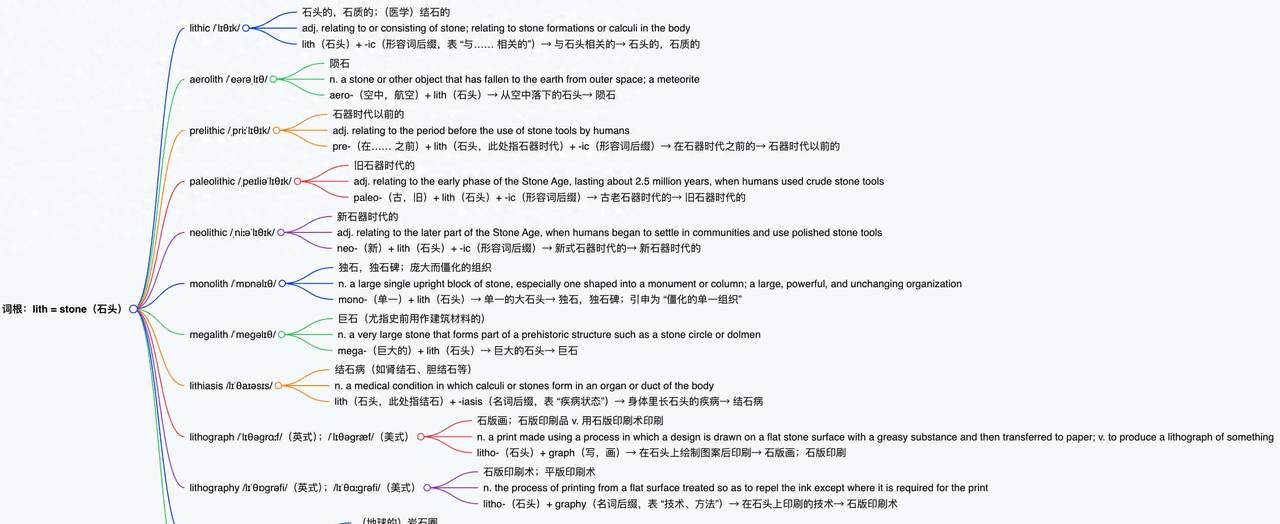
- lithic /ˈlɪθɪk/
中文释义: 石头的,石质的;(医学)结石的。
英文释义: adj. relating to or consisting of stone; relating to stone formations or calculi in the body.
构词: lith(石头)+ -ic(形容词后缀,表 “与…… 相关的”)→ 与石头相关的→ 石头的,石质的。
例句: The archaeologists found some lithic tools in the cave.(考古学家在洞穴里发现了一些石制工具。) - aerolith /ˈeərəˌlɪθ/
中文释义: 陨石。
英文释义: n. a stone or other object that has fallen to the earth from outer space; a meteorite.
构词: aero-(空中,航空)+ lith(石头)→ 从空中落下的石头→ 陨石。
例句: The aerolith that crashed in the desert was later studied by geologists.(那块坠落在沙漠里的陨石后来被地质学家研究了。) - prelithic /ˌpriːˈlɪθɪk/
中文释义: 石器时代以前的。
英文释义: adj. relating to the period before the use of stone tools by humans.
构词: pre-(在…… 之前)+ lith(石头,此处指石器时代)+ -ic(形容词后缀)→ 在石器时代之前的→ 石器时代以前的。
例句: Prelithic humans relied on wooden tools and animal bones for survival.(石器时代以前的人类依靠木制工具和动物骨骼生存。) - paleolithic /ˌpeɪliəˈlɪθɪk/
中文释义: 旧石器时代的。
英文释义: adj. relating to the early phase of the Stone Age, lasting about 2.5 million years, when humans used crude stone tools.
构词: paleo-(古,旧)+ lith(石头)+ -ic(形容词后缀)→ 古老石器时代的→ 旧石器时代的。
例句: The Paleolithic period is also known as the Old Stone Age.(旧石器时代也被称为旧石器时期。) - neolithic /ˌniːəˈlɪθɪk/
中文释义: 新石器时代的。
英文释义: adj. relating to the later part of the Stone Age, when humans began to settle in communities and use polished stone tools.
构词: neo-(新)+ lith(石头)+ -ic(形容词后缀)→ 新式石器时代的→ 新石器时代的。
例句: The Neolithic Revolution marked the beginning of agriculture and animal domestication.(新石器时代革命标志着农业和动物驯化的开端。) - monolith /ˈmɒnəlɪθ/
中文释义: 独石,独石碑;庞大而僵化的组织。
英文释义: n. a large single upright block of stone, especially one shaped into a monument or column; a large, powerful, and unchanging organization.
构词: mono-(单一)+ lith(石头)→ 单一的大石头→ 独石,独石碑;引申为 “僵化的单一组织”。
例句: The ancient monolith stands in the center of the square, attracting many tourists.(那块古老的独石碑矗立在广场中央,吸引着众多游客。)/ The company was once a bureaucratic monolith.(这家公司曾是一个官僚主义的僵化大组织。) - megalith /ˈmeɡəlɪθ/
中文释义: 巨石(尤指史前用作建筑材料的)。
英文释义: n. a very large stone that forms part of a prehistoric structure such as a stone circle or dolmen.
构词: mega-(巨大的)+ lith(石头)→ 巨大的石头→ 巨石。
例句: Stonehenge is a famous prehistoric monument made of megaliths.(巨石阵是一座由巨石建成的著名史前遗迹。) - lithiasis /lɪˈθaɪəsɪs/
中文释义: 结石病(如肾结石、胆结石等)。
英文释义: n. a medical condition in which calculi or stones form in an organ or duct of the body.
构词: lith(石头,此处指结石)+ -iasis(名词后缀,表 “疾病状态”)→ 身体里长石头的疾病→ 结石病。
例句: Drinking plenty of water can help prevent lithiasis in the kidneys.(多喝水有助于预防肾结石病。) - lithograph /ˈlɪθəɡrɑːf/(英式);/ˈlɪθəɡræf/(美式)
中文释义: 石版画;石版印刷品 v. 用石版印刷术印刷。
英文释义: n. a print made using a process in which a design is drawn on a flat stone surface with a greasy substance and then transferred to paper; v. to produce a lithograph of something.
构词: litho-(石头)+ graph(写,画)→ 在石头上绘制图案后印刷→ 石版画;石版印刷。
例句: The artist created a beautiful lithograph of the city skyline.(这位艺术家创作了一幅精美的城市天际线石版画。) - lithography /lɪˈθɒɡrəfi/(英式);/lɪˈθɑːɡrəfi/(美式)(增补词)
中文释义: 石版印刷术;平版印刷术。
英文释义: n. the process of printing from a flat surface treated so as to repel the ink except where it is required for the print.
构词: litho-(石头)+ graphy(名词后缀,表 “技术、方法”)→ 在石头上印刷的技术→ 石版印刷术。
例句: Lithography is widely used in the production of posters and books.(石版印刷术广泛应用于海报和书籍的制作中。) - lithosphere /ˈlɪθəsfɪə(r)/(增补词)
中文释义: (地球的)岩石圈。
英文释义: n. the rigid outer part of the earth, consisting of the crust and upper mantle.构词: litho-(石头)+ sphere(球体,圈层)→ 由石头构成的地球外层→ 岩石圈。
例句: The lithosphere is divided into several large tectonic plates.(岩石圈被划分为几个大型构造板块。) - megalithic /ˌmeɡəˈlɪθɪk/(增补词)
中文释义: 巨石的;与巨石建筑有关的。
英文释义: adj. relating to or consisting of megaliths; relating to the prehistoric period when megaliths were used.
构词: megalith(巨石)+ -ic(形容词后缀)→ 与巨石相关的→ 巨石的。
例句: The megalithic structures in Brittany are among the most famous in Europe.(布列塔尼的巨石建筑是欧洲最著名的建筑之一。)
特别说明一、特别说明
- 词根含义的延伸
“lith” 的核心含义是 “石头”,在构词中可根据语境延伸出不同指向:
一是具体的石头形态(如 monolith 独石、megalith 巨石);
二是与石头相关的时代(如 paleolithic 旧石器时代、neolithic 新石器时代);
三是专业领域的引申义,在医学中表明 “结石”(如 lithiasis 结石病),在地质学中表明 “岩石圈层”(如 lithosphere 岩石圈),在印刷术中表明 “石板”(如 lithograph 石版画)。 - 词根变体与前缀搭配规律
该词根常以 “litho-” 的复合前缀形式出现(如 lithography、lithosphere),用于构成专业术语;
同时常与表明 “时间、大小、空间” 的前缀搭配,例如:
表时间:paleo-(古)、neo-(新)、pre-(前);
表大小:mono-(单一)、mega-(巨大);表空间:aero-(空中)。 - 专业词汇的使用场景
多数单词属于考古学、地质学、医学等专业领域词汇,日常口语中使用频率较低。
例如 “lithiasis” 仅用于医学诊断,“lithosphere” 是地质学核心术语,“megalithic” 多用于描述史前遗迹,需根据使用场景区分专业性和通用性。
二、记忆方法
- 前缀 + 词根联动记忆法
利用前缀的语义指向,快速推导单词含义,形成系列化记忆:
时间维度前缀:
pre-(前)+ lith → prelithic(石器时代前的);
paleo-(古)+ lith → paleolithic(旧石器的);
neo-(新)+ lith → neolithic(新石器的);
大小维度前缀:
mono-(单)+ lith → monolith(独石);
mega-(大)+ lith → megalith(巨石);
空间维度前缀:
aero-(空中)+ lith → aerolith(陨石)。 - 场景分类记忆法
按单词所属的专业领域分类,强化关联记忆:
考古学领域:paleolithic、neolithic、megalith、megalithic;
地质学领域:lithic、lithosphere、aerolith;
医学领域:lithiasis;
印刷领域:lithograph、lithography。 - 词性转换规律记忆
该词根下单词多遵循 “名词→形容词” 的转换规律,通过后缀 “-ic” 实现,例如:
megalith(名词,巨石)→ megalithic(形容词,巨石的);
lith(词根,石头)→ lithic(形容词,石质的)。
三、注意点
- 发音细节
“lith” 部分的发音为 /ˈlɪθ/,注意 “th” 发清辅音 /θ/,需咬舌尖,不可误读为 /s/ 或 /t/;
“paleolithic” 和 “neolithic” 重音均在倒数第二个音节,分别为 /ˌpeɪliəˈlɪθɪk/、/ˌniːəˈlɪθɪk/,避免重音前置;
“lithograph” 英式发音为 /ˈlɪθəɡrɑːf/,美式发音为 /ˈlɪθəɡræf/,注意结尾元音的差异。 - 易混淆单词辨析monolith vs megalith:
二者均与石头相关,“monolith” 强调 “单一的大块石头”,可引申为 “僵化组织”;“megalith” 强调 “巨大的石头”,多用于史前建筑场景;
paleolithic vs neolithic:均属于石器时代,“paleolithic” 是旧石器时代,人类使用粗糙打制石器,过着狩猎采集生活;“neolithic” 是新石器时代,人类使用打磨石器,开始定居农耕。 - 拼写易错点
单词中 “lith” 部分易误写为 “lite” 或 “lithy”,例如 “lithic” 不可写成 “litic”,“lithiasis” 不可写成 “litiasis”;
长单词如 “paleolithic”“neolithic” 易漏写中间的 “o”,记忆时可拆分前缀和词根(paleo- + lith + -ic)逐段拼写。
© 版权声明
文章版权归作者所有,未经允许请勿转载。
相关文章




暂无评论...